
Mobility & Transfers
A Deep-Dive Explanation for Supporting Dementia
What “Mobility” Actually Means in Dementia Care
Mobility refers to the person’s ability to move their body safely and confidently through space, including:
Standing up from any surface
Sitting down with balance and stability
Turning or adjusting their posture
Walking short or long distances
Getting into or out of bed
Moving onto or off a toilet or shower seat
Stepping over thresholds or navigating stairs
Reaching, bending, or shifting weight
For dementia caregivers, mobility is not just physical.
It’s mental, emotional, environmental, and relational.
Mobility is tied to:
Independence (the person’s sense of identity)
Safety (fall prevention)
Dignity (preserving function)
Emotional security (trusting the caregiver)
Health (preventing pressure sores, stiffness, decline)
When mobility becomes harder, the person may feel scared, powerless, or embarrassed.
Understanding mobility deeply helps the caregiver avoid misinterpretations like:
“They’re being stubborn.”
“They don’t want to help themselves.”
“They’re acting difficult.”
These reactions are symptoms, not personality traits.
How Dementia Changes the Brain’s Relationship With Movement
Dementia affects multiple brain systems responsible for mobility, including:
1. The Balance System (Vestibular Function)
The brain has trouble knowing where the body is in space.
Effects:
Leaning too far forward or backward
Wobbling
Taking short, hesitant steps
Fear of starting a movement
2. Depth Perception
The person misjudges height, distance, lighting, shadows, and flooring patterns.
Effects:
Thinking a dark rug is a hole
Believing shiny floors are slippery
Feeling stairs look “steeper”
Freezing at thresholds or doorways
3. Memory and Motor Planning (Apraxia)
The brain forgets how to perform movement steps in order.
Effects:
Sitting when asked to stand
Standing when told to sit
Unable to coordinate feet and hands together
Needing much more time to respond to instructions
4. Body Awareness (Proprioception)
The person doesn’t fully sense where their legs, hands, or feet are positioned.
Effects:
Missing the chair while sitting
Placing feet unevenly
Misjudging steps
Feeling unsteady during standing
5. Emotional Regulation
Emotions become more intense while the ability to understand them decreases.
Movement triggers fear faster.
Effects:
Panic
Clinging
Refusal
Sudden yelling
Crying
Freezing
Here is a direct breakdown of what causes a behavior and what outcome it creates, so a caregiver can identify issues instantly
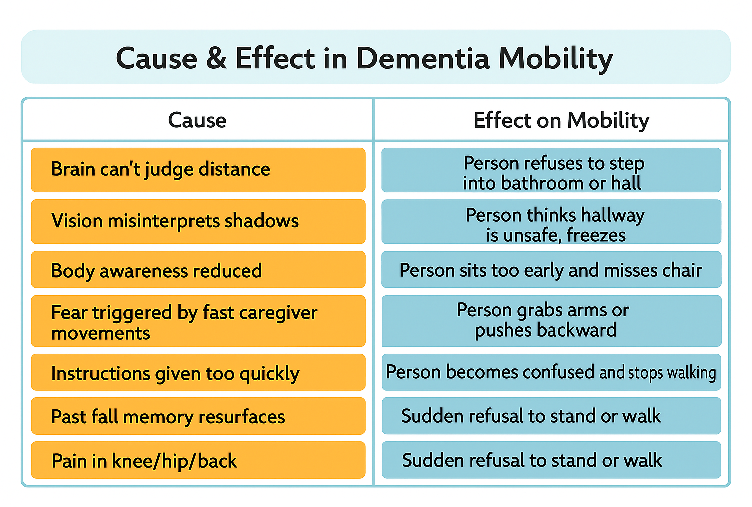
Scenarios: These are teachable stories
Scenario 1: The “I Can’t Stand Up” Moment
Mrs. L is asked to stand from her recliner.
She pushes but immediately falls backward into the chair and looks terrified.
What most caregivers assume:
“She’s weak.”
or
“She’s not trying.”
What’s actually happening:
Her brain cannot coordinate the steps of:
Leaning forward
Weight shifting
Pushing through the legs
Her fear takes over before her body moves.
Correct caregiver response:
The caregiver kneels in front of her and says:
“Let’s do this slowly together. Scoot forward first… good. Now lean toward me… perfect. On three, we stand.”
Outcome:
She stands on the first try.
Not because her body suddenly improved —
but because her fear decreased and her brain was guided step-by-step.
Scenario 2: The “Freezing at the Doorway” Situation
Mr. D walks confidently until he reaches the hallway.
He suddenly stops and refuses to move, clutching his walker.
Possible misinterpretations:
“He’s being stubborn.”
“He doesn’t want to go.”
Actual cause:
The darker shade of flooring in the hallway looks like a step down.
His brain believes he will fall.
Correct caregiver approach:
The caregiver steps onto the hallway floor first and says:
“Watch my feet. The floor is even. It’s safe.”
She moves slowly so he has time to process visually.
Outcome:
He begins walking again once he sees the floor is safe for her.
Scenario 3: The “Why Are They Pacing?” Mystery
Mrs. B has walked 12 laps around the living room.
A caregiver may worry she is agitated or trying to leave.
Actual causes may include:
Searching for someone from her past
Reliving old routines
Restlessness from anxiety
Understimulation
Needing the bathroom
Feeling unsure of the environment
Correct caregiver approach:
Walk beside her and ask:
“Are we looking for something?”
She replies, “My mother.”
The caregiver responds:
“You miss her. Tell me about her.”
Outcome:
Her pacing slows.
She feels safe and emotionally met.
Scenario 4: The “I’m Going to Fall!” Panic
Mr. R begins shaking halfway through a transfer.
He clings tightly and says: “I’ll fall, I’ll fall!”
Cause:
The movement felt too fast or unexpected.
His brain immediately sounded the “danger” alarm.
Correct caregiver approach:
Slow everything down.
Make eye contact.
Say:
“You’re safe. I won’t let you fall. Let’s pause for a moment.”
Outcome:
His fear drops.
He completes the transfer safely.
Understanding Constant Movement in Dementia
Pacing • Wandering • Walking Without Purpose • Repetitive Movement
What Constant Movement REALLY Means
Constant movement—including pacing, walking in circles, repeatedly getting up, or checking doors—is communication, not “wandering” or “misbehavior.”
The person is expressing something their brain can’t put into words.
Constant movement is a message.
Your job as the caregiver is to interpret it safely.
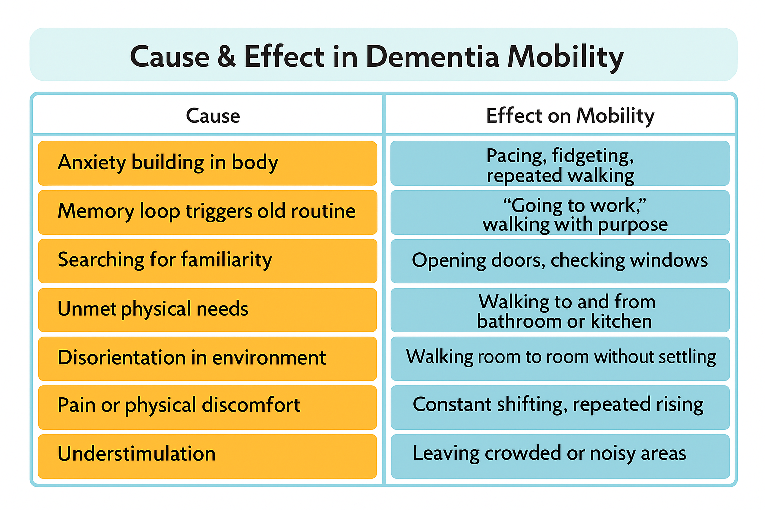
Why People With Dementia Move Constantly
There are 8 major reasons, all rooted in brain changes:
1. Internal Restlessness
The nervous system becomes hyperactive.
Movement lowers the discomfort they can’t explain.
Effect:
They walk constantly, unable to settle in chairs or beds.
2. Emotional Dysregulation
They may feel uneasy, worried, or scared without knowing why.
Effect:
Movement helps release emotional tension.
3. Memory Loops
The brain retrieves old routines, tasks, or habits.
Examples:
“I need to go to work.”
“I need to pick up the kids.”
“I’m supposed to check the oven.”
These are deeply ingrained procedural memories.
Effect:
They walk with purpose — even if the purpose is outdated.
4. Searching for Something Familiar
They may feel lost in their own home.
The brain says:
“Find something recognizable.”
Effect:
They open doors, drawers, closets, or walk hall to hall.
5. Physical Discomfort
Pain or discomfort triggers movement because sitting still increases it.
Examples:
Constipation
Hip/knee/foot pain
Hunger
Needing the bathroom
Clothing too tight
Effect:
They walk because their body is asking for relief.
6. Sensory Needs
Movement regulates the sensory system.
Effect:
Walking helps them feel grounded and “in their body.”
7. Understimulation or Boredom
If the environment offers little stimulation, the brain creates its own activity.
Effect:
They walk because there’s nothing else to engage with.
8. Anxiety From Unpredictability
If the environment or routine feels unsafe, movement becomes safety-seeking behavior.
Effect:
They stay on the move to stay in control.
<!DOCTYPE html>
<html>
<style>
table, th, td {
  border:1px solid black;
}
</style>
<body>


<table style="width:100%">
  <tr>
    <th>Cause</th>
    <th>Effect on Mobility</th>
  </tr>
  <tr>
    <td>Brain can't judge distance</td>
    <td>Person refuses to step into bathroom or hall</td>
    </tr>
  <tr>
    <td>Vision misinterprets shadows</td>
    <td>Person thinks hallway is unsafe, freezes</td>
    </tr>
  <tr>
    <td>Body awareness reduced</td>
    <td>Person sits too early and misses chair</td>
     </tr>
  <tr>
    <td>Fear triggered by fast caregiver movements</td>
    <td>Person grabs arms or pushes backward</td>
  </tr>
  <tr>
    <td>Instructions given too quickly</td>
    <td>Person becomes confused and stops walking</td>
    </tr>
  <tr>
    <td>Past fall memory resurfaces</td>
    <td>Person panics even if movement is safe</td>
     </tr>
  <tr>
    <td>Pain in knee/hip/back</td>
    <td>Sudden refusal to stand or walk</td>
  </tr>
</table>


</body>
</html>
| Cause | Effect on Mobility |
|---|---|
| Brain can't judge distance | Person refuses to step into bathroom or hall |
| Vision misinterprets shadows | Person thinks hallway is unsafe, freezes |
| Body awareness reduced | Person sits too early and misses chair |
| Fear triggered by fast caregiver movements | Person grabs arms or pushes backward |
| Instructions given too quickly | Person becomes confused and stops walking |
| Past fall memory resurfaces | Person panics even if movement is safe |
| Pain in knee/hip/back | Sudden refusal to stand or walk |
Scenarios: These are teachable stories
⭐ Scenario 1: The Repetitive Hallway Walk
Mr. P walks from the living room → hallway → back → repeat.
His daughter thinks he's “wandering for no reason.”
Caregiver observation:
He keeps touching his stomach slightly.
Correct interpretation:
This might signal discomfort, constipation, hunger, or bathroom needs.
Caregiver approach:
Walk beside him and ask gently:
“Do you need the bathroom or a snack?”
He says, “Bathroom.”
Once he goes, the pacing decreases dramatically.
Lesson:
Movement expressed a physical need.
⭐ Scenario 2: The “Looking for Work” Loop
Mrs. N keeps checking the front door with urgency.
Family assumes:
“She’s trying to leave the house.”
Actual cause:
She used to leave for work through that same door every morning for 40 years.
Time-of-day triggers the routine.
Caregiver approach:
Stand beside her and say:
“Work called—you’re off today. But I could use help folding these towels.”
This replaces her need to act with a safe, purposeful task.
Lesson:
Old routines live long after memory fades.
⭐ Scenario 3: The Unsafe Scatter-Walk
Mr. J keeps standing up and sitting down repeatedly.
He looks anxious, hands shaking.
Possible misinterpretation:
“He won’t stay put!”
Actual cause:
Internal anxiety is peaking.
Caregiver response:
Sit next to him (NOT in front).
Offer your hand slowly.
Say:
“I’m right here. Let’s take a breath together.”
His breathing slows, and the getting up stops.
Lesson:
Anxiety was communicating through movement.
⭐ Scenario 4: The “I’m Lost in My Own Home” Loop
Mrs. T wanders room to room and says: “Where is everyone?”
Cause:
Disorientation + emotional insecurity.
Caregiver approach:
Never say “You’re in your own home.”
Instead say:
“Let’s sit together for a minute. You’re not alone—I’m right here.”
Her wandering slows because her emotional need is finally met.
Lesson:
Movement expresses fear of being alone or confused.
Anxiety and Agitation
How Caregivers Should Respond to Constant Movement
✔ Walk WITH them, not against them
Joining them communicates safety and partnership.
✔ Never force them to sit “because they’re tired”
Their brain may need movement to cope with internal distress.
✔ Ask supportive questions
“Are we looking for something?”
“Would you like company?”
“Are you comfortable?”
“Do you want water or the bathroom?”
✔ Check for physical needs
Most pacing is rooted in unmet needs.
✔ Create a safe walking route
Clear hallways, stable furniture, good lighting.
✔ Offer meaningful redirection
Folding towels, wiping tables, looking at photo books — safe “purposeful tasks.”
✔ Validate their emotional world
Never dismiss or correct their reasons for walking.
Recognizing and Responding to Fear of Falling
What Fear of Falling REALLY Is
Fear of falling in dementia is not a simple fear —
it is a full-body, full-brain warning alarm that activates instantly, often without clear cause.
To the person, the fear is REAL, intense, and physical.
The brain’s “safety system” struggles to judge balance, height, and stability, so it overreacts to protect the person.
This fear drives MOST mobility problems in dementia care.
How the Brain Creates Fear of Falling
1. Misjudged Distance
The brain cannot correctly interpret how far the floor or chair is.
Effect:
Refusing to stand or sit
Grabbing tightly
Sudden dropping into chairs
2. Misinterpreted Vision
Depth perception declines.
Effect:
Carpet = hole
Tile = cliff
Threshold = step
Shower floor = slippery danger
Black mat = pit
3. Loss of Balance Awareness
The brain can’t feel whether the body is stable.
Effect:
Leaning backward suddenly
Clutching the caregiver
Panicking mid-step
4. Past Falls Stored as Trauma
The body remembers danger, even if the mind forgets the event.
Effect:
Strong freeze or panic response whenever movement is expected.
5. Overwhelmed by Instructions
The person can’t process multiple steps at once.
Effect:
Freezing
“No!” responses
Panic
Refusal
6. Caregiver Moves Too Quickly
Fast motions are interpreted as threats.
Effect:
Flinching
Clinging
Fear spike
Resistance
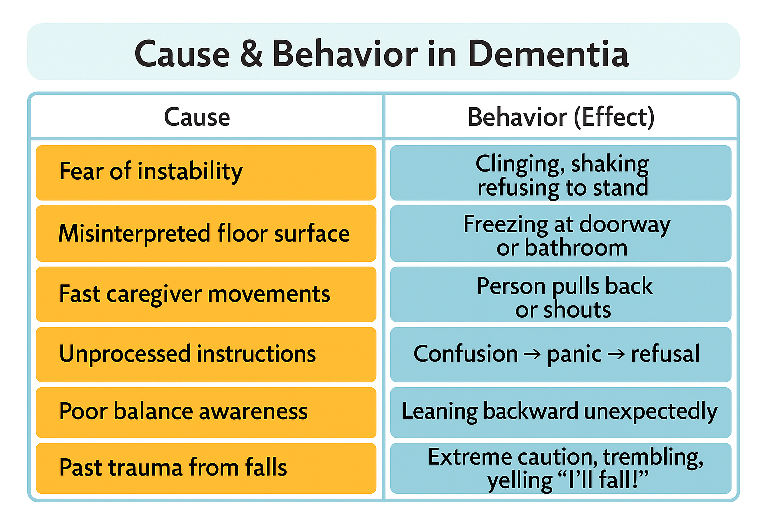
HOW TO RECOGNIZE FEAR OF FALLING INSTANTLY
Common signs include:
A sudden halt or freeze
Widened eyes
Shallow breathing
Repetition of “Wait, wait!”
Reaching for walls/furniture
Leaning backward
Grabbing caregiver tightly
Whimpering or crying
Shaking knees
Saying “Don’t let me fall!”
Refusing to move
Remember:
Fear is not defiance. Fear is protection.
Scenarios: These are teachable stories
⭐ Scenario 1: The Transfer Panic
Mrs. C needs to stand from her recliner.
When the caregiver begins the transfer too quickly, Mrs. C screams, “STOP!”
What’s happening internally:
Her brain lost track of where her body is.
Standing felt like falling.
Correct caregiver approach:
The caregiver pauses and kneels to her eye level:
“We’re not rushing. You’re safe. Let’s breathe together.”
Then:
“First we wiggle forward… good. Now lean your chest toward me.”
Outcome:
Her fear decreases.
She stands successfully — not because she got stronger, but because she felt safe.
⭐ Scenario 2: The Bathroom Threshold Freeze
Mr. L stops at the bathroom door and refuses to enter.
Cause:
Bathroom tile is shiny — his brain sees it as slippery or wet.
Incorrect response:
“Come on, it’s not slippery.”
Correct response:
Step onto the bathroom tile yourself and say:
“Look, it’s safe. I’ll go first and hold your hand.”
You demonstrate slowly — giving his brain confidence.
Outcome:
He follows safely.
⭐ Scenario 3: The Sudden Backward Lean
Mrs. U leans backward every time someone tries to help her stand.
Cause:
Her brain senses she is falling forward, even when she isn’t.
Correct caregiver approach:
Place one hand on her upper back (not pulling — just reassuring),
and say:
“I’ve got your back. Lean forward with me… nose over toes.”
Outcome:
She shifts weight safely because the fear center in her brain feels supported.
⭐ Scenario 4: The Walker Panic
When walking, Mr. S keeps saying, “I’m slipping! I’m slipping!” even though the floor is clean and dry.
Cause:
His brain misreads floor texture OR he feels dizzy from medications.
Correct caregiver approach:
Slow the pace.
Place your hand near his elbow (not gripping).
Say:
“You’re steady. I’m right beside you. Let’s take slow steps.”
Outcome:
His panic decreases and walking becomes smoother.
HOW TO RESPOND TO FEAR OF FALLING
✔ Slow everything down
Fear drops as speed decreases.
✔ Validate the fear
Invalidating fear increases panic.
Say:
“I know this feels scary.”
“I’m right here.”
“We’ll do this together.”
✔ Use one clear step at a time
The brain needs simple, predictable direction.
✔ Approach from the front
Unexpected touch increases fear.
✔ Create stability with your posture
Your body must look balanced and calm.
✔ Let the person hold YOU (not the other way around)
It increases their sense of control.
Fall Mitigation: Creating a Safe, Predictable Environment
Why Falls Happen in Dementia
Falls are rarely caused by weakness alone.
They happen because the environment becomes confusing to the brain.
A person with dementia may misinterpret:
Shadows
Patterns
Carpets
Steps
Reflections
Furniture positioning
This creates huge fear spikes and hesitation during movement.
Environmental Triggers That Increase Fall Risk
1. Poor Lighting
Dim areas create shadows that look dangerous.
2. Sudden Light Changes
Bright → dim = disorientation
Dim → bright = overwhelm
3. Floor Pattern Changes
Dark → light flooring looks like a step.
4. Clutter
Shoes, papers, cords, pet toys all become hazards.
5. Loose Rugs
Even a tiny corner lifted ¼ inch can cause trips.
6. Noise
Sudden noise causes the person to stop or turn suddenly.
7. Furniture Rearrangement
The brain relies heavily on routine; changes cause confusion.
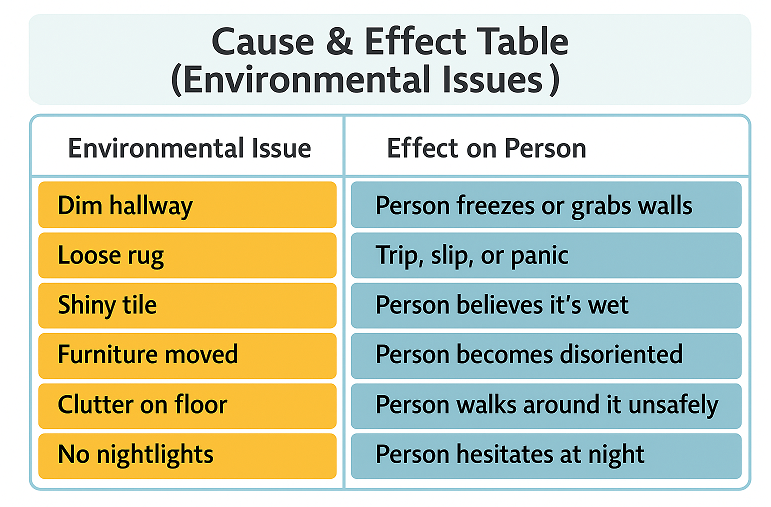
Scenarios: These are teachable stories
⭐ Scenario 1: The Hallway Shadow
Mrs. Y refuses to walk down the hallway.
Cause:
A dark shadow falls across the middle of the floor — her brain sees it as a hole.
Correct caregiver approach:
Turn on lights.
Stand in the shadow and say:
“It’s solid — look, I’m standing on it.”
Walk slowly across it.
Outcome:
She follows with confidence.
⭐ Scenario 2: The Invisible Pet Hazard
Mr. K walks carefully because he senses something underfoot.
Caregiver observes:
A small dog toy is half under the couch.
Correct response:
Remove all small objects from his walking path daily.
Outcome:
His gait speeds up because he trusts the flooring again.
⭐ Scenario 3: The Furniture Rearrangement Issue
Mrs. Q almost falls near the kitchen.
Cause:
Her son moved the table two feet to the left.
Her brain expected it to be where it always is.
Correct approach:
Restore predictable pathways.
Never rearrange furniture without reason — predictability = safety.
⭐ Scenario 4: The Doorway Freeze (Again, But From Environment)
Mr. L stops at every doorway at night.
Cause:
Light inside room is off → doorway looks like a black square.
Correct caregiver strategy:
Use nightlights or leave the door cracked with gentle lighting.
Outcome:
Doorways feel safe again.
What Caregivers MUST Do to Prevent Falls
✔ Daily clear pathways
Morning and evening walk-throughs.
✔ Strong lighting
Bright, even, warm lighting in every area they move through.
✔ No loose socks or slippers
Only closed-back shoes with traction.
✔ Predictable environment
Same furniture. Same pathway. Same walker placement.
✔ Bathroom safety
Grab bars, nightlights, non-slip mats.
✔ Slow-paced movement
Fast movement = higher fall risk.
✔ Check for fatigue
Tired legs fall quickly.
SECTION 4 Summary
Caregiver must know:
Common environmental hazards
How dementia changes perception of flooring and shadows
How lighting affects mobility
How consistency reduces falls
Why rearranging furniture is unsafe
Practical daily safety steps
⭐ SECTION 5
Supporting Safe Transfers
Standing • Sitting • Bed Mobility • Toilet Transfers • Shower Transfers
Why Transfers Are Difficult in Dementia
Transfers look simple to an observer, but to a person with dementia, a transfer is actually multiple complicated steps, all of which require:
Balance
Weight shifting
Depth perception
Muscle coordination
Memory of how to move
Understanding instructions
Emotional confidence
Trust in the caregiver
Dementia affects every single one of these ingredients.
This means transfers must be:
slow, predictable, steady, guided, and broken into tiny parts.
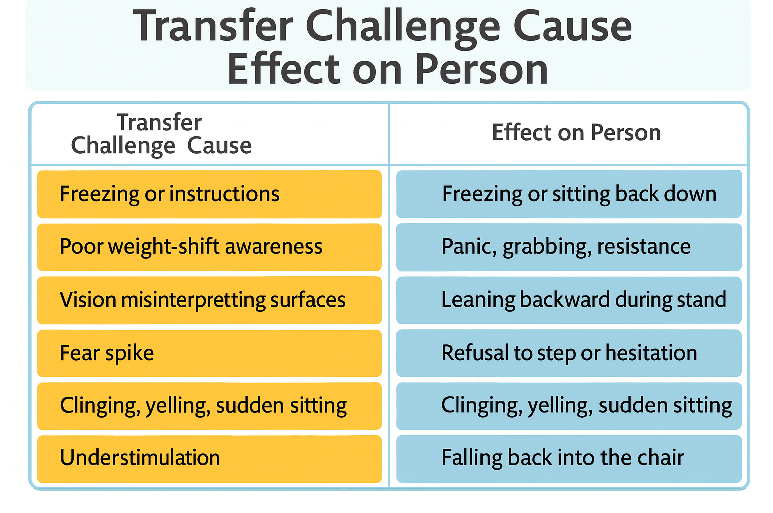
How The Brain Interferes With Transfers
1. The brain cannot break tasks into steps.
Transfers feel like a single lump of “movement,” which is overwhelming.
Effect:
The person feels panicked, confused, or stuck.
2. The person cannot feel where their body is positioned.
They may not know if they are leaning too far or too little.
Effect:
Leaning backward
Falling forward
Sitting too early
Standing too fast
3. Fear becomes physical resistance.
If the brain senses danger, muscles tense automatically.
Effect:
Pulling back
Gripping
Refusing to move
Sudden sitting
4. Misinterpreted vision impacts decision-making.
Transitional surfaces look unsafe.
Effect:
Freezing
Saying “No!”
Stepping incorrectly
⭐ THE GOLDEN TRANSFER TECHNIQUE
“Nose Over Toes”
This is the MOST important rule for safe standing.
To stand safely, the person must:
Scoot forward
Bend at the waist
Bring nose forward over knees
THEN push up
If their torso stays upright, balance is impossible.
The 4-Step Transfer Method (Simple + Dementia-Friendly)
Step 1: Prepare the Surface and Body
Check shoes
Ensure walker is in place if needed
Remove clutter
Turn on lighting
Step 2: Explain BEFORE touching
Use one-step instructions:
“Let’s scoot forward.”
“Now bring your chest toward me.”
Step 3: Create stability with your stance
Feet shoulder width apart
One foot slightly behind
Arms at mid-back or trunk, NOT pulling arms
Step 4: Rise together
Say:
“On three… 1… 2… 3…”
Stand slowly and steadily.
Scenarios: These are teachable stories
⭐ Scenario 1: The “Falling Back” Stand Attempt
Mrs. E tries to stand and drops back into the chair.
Cause:
Her torso didn’t lean forward enough (no “nose over toes”).
Correct caregiver approach:
Gently place your hand on her upper back
Say:
“Lean toward me… good… now we stand together.”
Outcome:
She stands safely because weight has shifted forward.
⭐ Scenario 2: The Bed Transfer Freeze
Mr. J sits on the edge of the bed but won’t stand.
Cause:
Multiple steps at once feel overwhelming.
Correct caregiver approach:
Break it down:
“Feet flat on the floor.”
(wait 3 seconds)
“Scoot to the edge.”
(wait 2 seconds)
“Lean forward.”
(wait 2 seconds)
“Now we stand together.”
Small steps → Big success.
⭐ Scenario 3: The Toilet Transfer Terrified Response
Mrs. C stiffens and shakes when asked to stand from the toilet.
Cause:
Toilets are low, transfers feel unstable, bathroom echoes feel sharp.
Correct caregiver response:
Place hand on her shoulder
Say slowly:
“I’m right here. We’ll go slowly.”Encourage forward lean
Stand together on a count
Outcome:
Fear drops → control returns.
⭐ Scenario 4: The Shower Transfer With Sudden Resistance
Mr. S refuses to step into the shower stall.
Cause:
Shiny tile looks slippery.
Water sound triggers sensory overload.
Correct approach:
Turn water DOWN
Dry the floor in front of him
Show your own foot stepping inside:
“See? It’s dry and safe.”
Outcome:
He accepts movement once the environment feels trustworthy.
Managing Anxiety and Building Trust During Movement
Why Anxiety Is So Intense in Dementia
People with dementia feel emotions more strongly while having fewer tools to understand or express them.
Movement adds pressure because:
They don’t know what their body will do
They feel vulnerable
They rely on someone else for balance
Instructions feel confusing
Environments feel unpredictable
Anxiety becomes visible through the BODY.
Common Signs of Anxiety in Mobility
Repeating “no”
Pulling away
Tight grip on clothing/furniture
Panicked breathing
Eyes darting around
Sudden yelling or crying
Leaning backward
Refusing to move
Body stiffening
Sweating or trembling
These are NOT behavioral issues — they are fear responses.
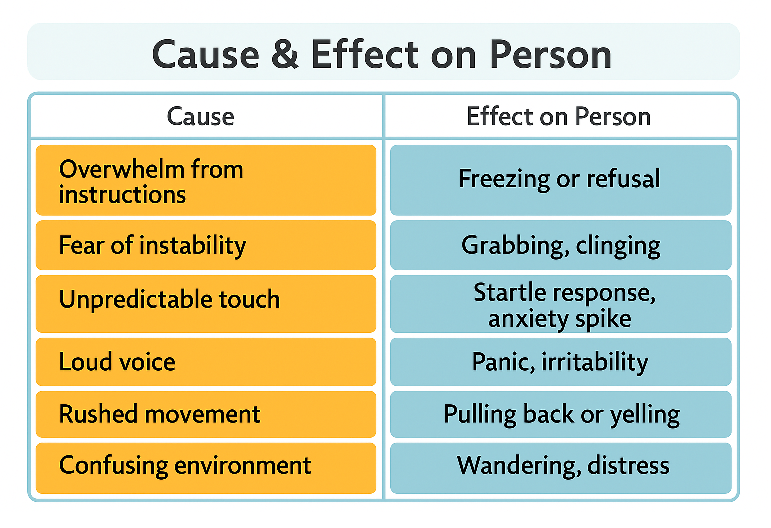
How to Lower Anxiety During Mobility Tasks
✔ 1. Slow Your Pace Dramatically
Your slowness creates their safety.
✔ 2. Use a Warm, Calm Tone
Soft tones help regulate their nervous system.
✔ 3. Validate Feelings (Not Facts)
Never say “You’re fine” or “Don’t be scared.”
Instead say:
“I know this feels scary.”
“I’ll stay right beside you.”
“We’ll go slowly.”
Validation lowers fear immediately.
✔ 4. Clarify Each Step
Overwhelm happens when instructions are too complex.
Break everything down:
“Stand.” → WRONG
“Scoot forward.” → pause → “Lean toward me.” → pause → “Now stand.” → CORRECT
✔ 5. Use Predictable Touch
Touch that is announced and slow increases trust.
✔ 6. Allow the Person to Control Pace
If they freeze, YOU freeze.
If they breathe fast, YOU breathe slower.
Scenarios: These are teachable stories
⭐ Scenario 1: The Sudden Panic Sit
Mr. K begins standing but suddenly sits down hard, shaking.
Cause:
He panicked mid-transfer because it felt too fast.
Correct caregiver approach:
Sit beside him
Softly say:
“That felt too fast. Let’s take more time.”Help him reset
Restart slower
Outcome:
Fear releases → cooperation increases.
⭐ Scenario 2: The Bathroom Crying Episode
Mrs. Y cries every time she approaches the bathroom.
Cause:
Bathrooms are overwhelming: echo, slippery tile, bright lights.
Caregiver approach:
Dim one light
Turn fan off
Approach slowly
Say:
“I’ll stay with you the whole time. You’re not alone.”
Outcome:
Her crying decreases and trust increases.
⭐ Scenario 3: The Angry Reaction
Mr. T shouts, “Leave me alone!” when the caregiver touches his arm to walk.
Cause:
Touch came too suddenly, triggering fear.
Correct response:
Step back slightly, soften the voice:
“May I help you up? I’ll move slow.”
Outcome:
Anger dissolves once he feels control and consent.
⭐ Scenario 4: The Silent Overwhelm
Some anxiety is silent: stiff posture, shallow breathing, wide eyes.
Cause:
Too many instructions at once.
Caregiver approach:
Switch to ONE simple instruction.
“Let’s take one step.”
Outcome:
The brain calms because demands decrease.
⭐ SECTION 7
Caregiver Body Language, Tone, and Pace
The Non-Verbal Skills That Make or Break Every Transfer
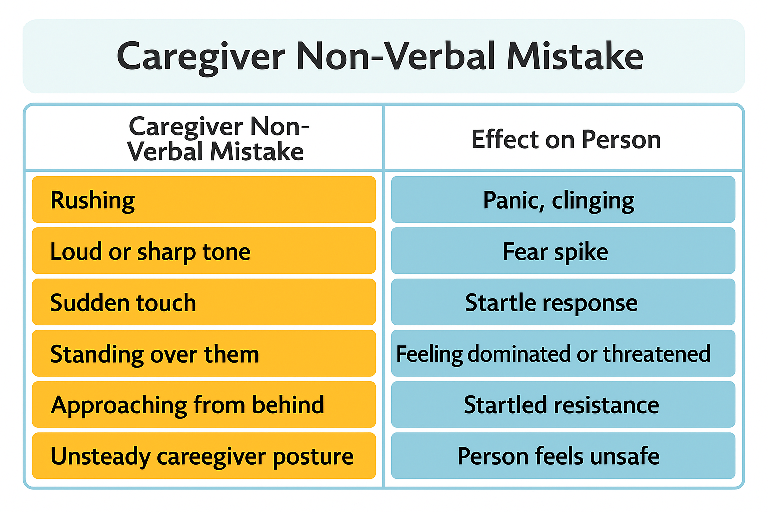
Why Non-Verbal Skills Matter So Much
People with dementia rely far more on tone, posture, facial expression, and movement than on words.
Your body communicates safety — or danger.
Before the person understands what you SAY,
they understand what you FEEL.
The Non-Verbal Elements That Matter Most
1. Pace
Move at half your normal speed.
Slower movements = less fear.
2. Voice Tone
Speak:
Low
Warm
Soft
Steady
Encouraging
Tone tells the brain:
“This is safe.”
3. Facial Expression
Never underestimate the power of a gentle smile.
Soft eyes lower tension.
4. Body Positioning
Always approach from the front.
Never grab from behind.
5. Predictability
All movement must be:
Announced
Slow
Repetitive in method
Familiar
6. Consistent Posture
Relaxed shoulders, steady feet.
Your stability becomes their stability.
Scenarios: These are teachable stories
⭐ Scenario 1: The Rushed Caregiver
The caregiver hurries toward Mrs. D saying, “Let’s go, we’re late!”
Effect:
Mrs. D panics, pulls away, and refuses to walk.
Correct approach:
Slow steps.
Soft voice:
“We have time. I’ll help you gently.”
Her body relaxes.
⭐ Scenario 2: The Comforting Approach
Mr. W looks nervous before standing.
Caregiver:
Slows her breathing
Softens her face
Holds out her hand palm-up
Says:
“I’ll stay right with you.”
Outcome:
He stands confidently.
⭐ Scenario 3: The Touch Without Warning
The caregiver places a hand on Mrs. K’s back suddenly.
Effect:
She jumps and shouts, “Don’t touch me!”
Correct approach:
Announce first:
“I’m going to place my hand on your back for support.”
Then move slowly.
⭐ Scenario 4: The Towering Stance
A caregiver stands over Mr. H, towering above him.
Effect:
He feels threatened, becomes stiff.
Correct approach:
Caregiver kneels to eye level.
“I’m right here with you.”
He relaxes immediately.
⭐ SECTION 8
Fatigue, Pain, and Medical Factors Affecting Mobility
Why Physical Discomfort Impacts Mobility So Strongly
People with dementia often cannot articulate:
“My hip hurts.”
“My foot is sore.”
“I’m dizzy.”
“I feel weak.”
“I didn’t sleep well.”
Instead, they express discomfort through behavior, especially during movement.
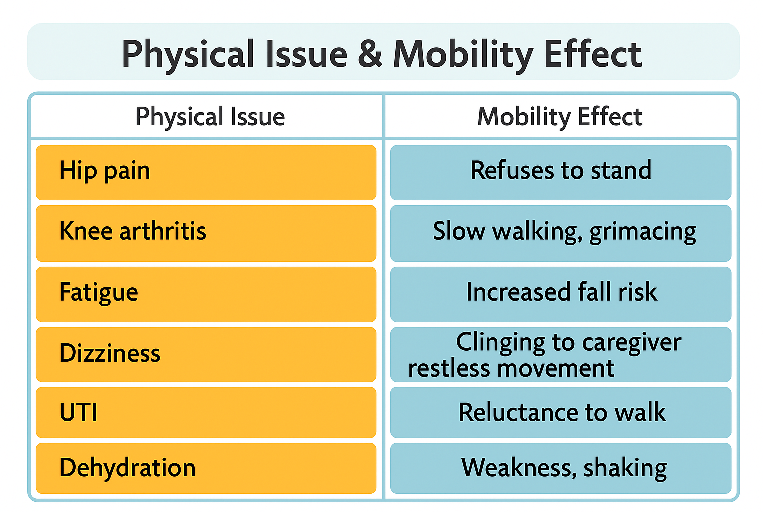
Common Physical Issues That Impact Mobility
1. Pain
Arthritis, back pain, hip pain, foot pain.
2. Fatigue
Little sleep = weak muscles and poor balance.
3. Medication Side Effects
Dizziness, low blood pressure, unsteadiness.
4. Illness
UTIs, dehydration, constipation, infections.
5. Muscle Weakness
From activity decline or illness.
6. Foot Problems
Corns, bunions, swelling, poor footwear.
Scenarios: These are teachable stories
⭐ Scenario 1: The Refusal to Stand
Mrs. F refuses to get out of her recliner.
Observation:
She rubs her knee repeatedly.
Cause:
Arthritis flare.
Correct caregiver approach:
Move slower, support her more, offer rest breaks, document pain.
⭐ Scenario 2: The Sudden Mobility Decline
Mr. S was walking normally yesterday but is unsteady today.
Cause:
Possible UTI or dehydration.
Correct action:
Observe symptoms → report → encourage fluids → move carefully.
⭐ Scenario 3: The Fatigue Wobble
Mrs. T barely slept overnight.
Today she leans heavily.
Cause:
Extreme fatigue decreases balance.
Correct approach:
Offer sitting tasks
Slow walking
Frequent rest
No long transfers
⭐ Scenario 4: The Foot Pain Shuffle
Mr. L begins shuffling feet and refuses shoes.
Cause:
Foot swelling or pain.
Correct approach:
Inspect feet, change footwear, notify team/family.
<p>Hello, World!</p>
<p>Hello, World!</p>
| Column 1 | Column 2 | Column 3 |
|---|---|---|
| Row 1, Col 1 | Row 1, Col 2 | Row 1, Col 3 |
| Row 2, Col 1 | Row 2, Col 2 | Row 2, Col 3 |
Hello, World!
| Column 1 | Column 2 | Column 3 |
|---|---|---|
| Row 1, Col 1 | Row 1, Col 2 | Row 1, Col 3 |
| Row 2, Col 1 | Row 2, Col 2 | Row 2, Col 3 |